
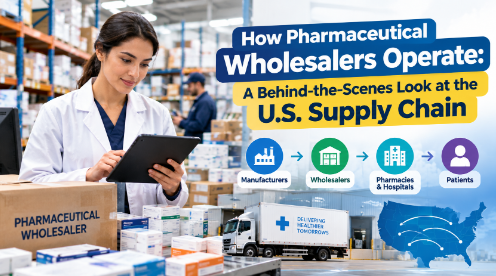
How Pharmaceutical Wholesalers Operate: A Behind-the-Scenes Look at the U.S. Supply Chain
Most people picture a pharmaceutical wholesaler as a warehouse that ships boxes faster than a pharmacy could source them alone. That picture misses the actual work. A shipment does not count as “supplied” the moment it leaves the floor.
It counts as supplied only after it clears a sequence of verification checkpoints: who handled it, whether the paperwork matches the product, and whether it stayed safe the entire way. In 2026, with DSCSA enforcement fully in effect, these checkpoints are not fine print. They are how pharmaceutical wholesalers operate, shipment after shipment.
This article walks through the four checkpoints a shipment must clear before reaching a pharmacy shelf:
- Licensing, state by state
- Trading-partner authorization under DSCSA
- Product-identity matching through serialization
- Custody and temperature control in transit
Checkpoint One: Is This Distributor Even Licensed to Touch the Product?
A federal registration does not guarantee a distributor can legally operate everywhere. Wholesale drug distribution is licensed state by state, and a distributor can hold valid federal credentials while lacking authorization in a specific state.
Most buyers assume licensing is a one-time credential. In practice, it requires:
- Continuous maintenance, not a single approval
- Rolling renewal cycles per state
- Ongoing audits by state boards of pharmacy
Lapses here are one of the common reasons a shipment gets held or rejected.
Think about a pharmacy in a state where a distributor’s license expired during renewal. The order is correct. The product is real. The shipment cannot go forward until the licensing issue is fixed.
That is why nationwide coverage matters for wholesalers—not just as something to say but, as something that actually works. Drugzone keeps licenses in all 50 states. So shipments never stop at a state border waiting for paperwork to catch up.
Checkpoint Two: Is Everyone Upstream and Downstream Who They Claim to Be?
Under the Drug Supply Chain Security Act, every party that touches a pharmaceutical product, from manufacturer to distributor to pharmacy, must be verified as an Authorized Trading Partner before a transaction proceeds. Buyers often assume this check happens once, at onboarding. It does not.
It is an ongoing verification applied to every transaction, checking:
- Current registration status of each partner
- Valid authorization under DSCSA for that transaction
- Documentation available on request, not just referenced
Accreditation is what makes this operational rather than a badge on a website. NABP accreditation and FDA registration give buyers a checkable way to confirm that wholesale pharmaceutical distributors in USA are who they claim to be, on every shipment.
A distributor that cannot produce that verification quickly is not operating within DSCSA’s framework. Asking for proof directly is a faster filter than marketing copy.
Checkpoint Three: Does the Paperwork Actually Match the Product?
Licensing and trading-partner status confirm who can move the product. The next checkpoint confirms the product itself, down to the individual unit, is genuinely what the paperwork says it is.
Serialization and Product Identifiers
Every saleable unit carries a unique product identifier, readable electronically:
- A serial number
- A lot number
- An expiration date
This is not a label formality. It lets a distributor prove, at the unit level, that the pharmaceutical wholesalers handling a product can trace it back to a verified manufacturing batch on demand.
Without that trace, a distributor is reselling on trust rather than verification, exactly the gap the Drug Supply Chain Security Act closes. A batch of generic cardiac medication might pass through a manufacturer then a distributor and then to a hospital pharmacy in days. At each handoff, the identifier must match the transaction data on file, or the product stops moving until someone resolves why.
When the Data Doesn’t Match: Exception Handling
Most content about pharmaceutical distribution stops at “the system verifies the product.” It rarely explains what happens when verification fails, which is where the real difference shows up.
A quarantine can be triggered by:
- A mismatched serial number
- An incomplete transaction record
- A scanning error at intake
A flagged unit exits saleable inventory immediately, before an investigation confirms whether it’s a documentation error or a genuine chain-of-custody problem.
This separates a compliant drug wholesale operation from one that merely owns compliance software. Having a scanning system proves nothing; nearly every distributor has one. Resolving a flagged exception cleanly and fast, without letting it reach a pharmacy shelf, is what this checkpoint tests.
Checkpoint Four: Did the Product Stay Safe the Entire Way?
Passing every documentation check means nothing if the product degraded in transit. Many buyers equate safe shipping with sturdy packaging and a tracking number.
The real checkpoint is a continuously monitored custody chain, with temperature tracking maintained through every stage:
- Intake at the warehouse
- Storage
- Picking and packing
- Outbound delivery
According to research cited by the Commonwealth Fund, roughly 92% of prescription drugs in the U.S. move through wholesale distributors before reaching a pharmacy, which is why custody controls at this scale matter to the entire healthcare system.
Facility infrastructure is what makes this checkpoint pass consistently, and it’s where a serious pharma wholesaler makes its biggest operational investment. Drugzone operates a 20,000-square-foot temperature-controlled facility built to hold products within required ranges from intake through delivery.
The Real Definition of “Operating”
Four checkpoints, run correctly on every shipment, separate a distributor that merely moves boxes from one that operates the way the role requires:
- Licensing verification
- Trading-partner verification
- Product-identity matching
- Custody control
These happen on every order for every customer, every day whether someone is watching or not.
Drugzone created its operation around meeting all four 50-state licensing, NABP accreditation, DSCSA 2025 compliance and a temperature-controlled facility built for custody integrity from intake, to delivery. For a hospital, pharmacy or long-term care buyer looking at a partner, that consistency, not warehouse size is what separates pharmaceutical wholesalers from the rest of the market.
Ready to work with a distribution partner built around these four checkpoints? Become a Customer with Drugzone.
Frequently Asked Questions
- What is the difference between a pharmaceutical wholesaler and a distributor?
In practice the terms are used interchangeably. Most buyers will not find a real difference. Both terms describe a party that buys pharmaceutical products from manufacturers and then supplies those products to pharmacies, hospitals and other licensed healthcare buyers. This process follows the DSCSA trading partner framework.
- Why do pharmaceutical shipments get held or delayed?
Most delays trace back to one of the four checkpoints above: an expired or lapsed state license, a trading partner that can’t be verified, a serialization mismatch that triggers quarantine, or a break in temperature-controlled custody. Delays from manufacturer-side shortages are a separate issue, usually outside a distributor’s control. A delay on the distribution side is almost always traceable to one of these four checkpoints.
- How can a healthcare buyer verify a distributor’s compliance before signing on?
Ask directly for proof of active state licensing, NABP accreditation, FDA registration, and DSCSA authorized trading partner status, and expect documentation, not a verbal assurance. A compliant distributor should produce this on request without delay. It’s also reasonable to ask how a distributor handles serialization exceptions, since the answer reveals more about operational maturity than any credential alone.